China’s instrumentation cable sector is becoming more important as factories adopt automation, digital control, and safer process monitoring. MarketsandMarkets reported that the global wire and cable market could grow from about USD 202.9 billion in 2023 to USD 278.4 billion by 2028. However, many reports group instrumentation cable with industrial, control, or specialty cables. Direct comparisons remain imperfect.
The selection challenge is practical. A refinery control room may need individually screened pairs, drain wires, flame-retardant insulation, and stable performance beside motors. A water-treatment plant may value moisture resistance and easier termination. These details separate serious manufacturers from attractive catalog claims. Béla G. Lipták, editor of the Instrument Engineers’ Handbook, offers a useful reminder: “Measurement is the basis of control.” The cable carries that measurement.
This guide examines leading Chinese manufacturers through more than production volume. It considers conductor quality, insulation systems, shielding design, factory testing, customization, export experience, and certification evidence. Public market studies from Grand View Research and Mordor Intelligence indicate continued demand for industrial and control cabling, supported by automation and infrastructure investment. Yet their market boundaries differ, so their figures should not be treated as identical.
No ranking is perfect.
Some suppliers communicate clearly but publish limited test data. Others have strong factories but weaker technical documentation. That difference matters. The following overview therefore focuses on verifiable capabilities, application experience, and buyer-side risks when identifying China’s top Instrumentation Cable manufacturers.
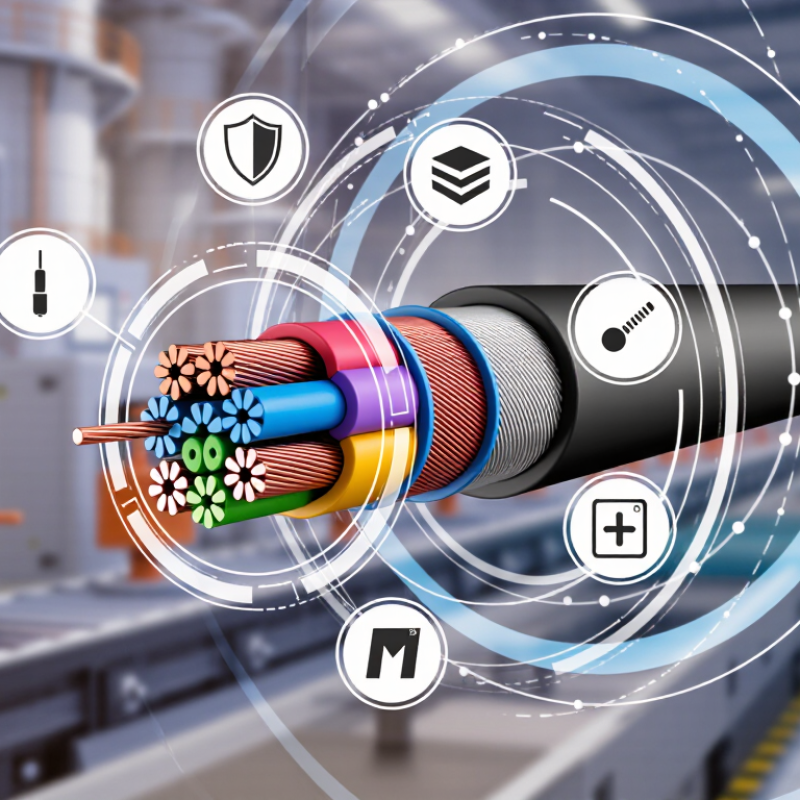
Instrumentation cables are designed to carry low-level measurement and control signals. They connect sensors, transmitters, controllers, and monitoring equipment. Unlike power cables, they must reduce electrical noise and signal distortion. A typical cable may include copper conductors, insulation, an overall shield, and a protective outer jacket. Some designs use individual pair shields for stronger separation. The drain wire helps connect the shield to ground. It is small but important. These cables are common in chemical plants, power stations, water treatment facilities, factories, and building automation systems. A temperature sensor, pressure transmitter, or flow meter may rely on this stable signal path.
When evaluating instrumentation cable manufacturers in China, buyers should examine more than price. Check conductor resistance, insulation materials, shielding coverage, operating temperature, and flame performance. Manufacturers serving industrial projects should provide clear test records and traceable production information. Compliance with relevant IEC or project standards also matters. In noisy areas, twisted pairs and suitable shielding can prevent unstable readings. In outdoor installations, sunlight, moisture, oil, and mechanical stress require stronger jacket materials. A datasheet can look convincing, yet installation conditions may expose weaknesses. Even careful selection can miss grounding problems or poor cable routing. I would request samples, inspect the construction, and confirm test methods before placing a large order. Practical details often reveal more than polished marketing language.
| Instrumentation Cable Type | Typical Conductor | Insulation and Sheath | Shielding Arrangement | Typical Voltage Rating | Typical Temperature Range | Common Applications | Relevant Standards or Practices |
|---|---|---|---|---|---|---|---|
| Single Pair, Overall Shielded | Solid or stranded annealed copper, commonly 18–24 AWG | PVC, PE, or low-smoke zero-halogen insulation with PVC or LSZH outer sheath | Aluminum/polyester foil with drain wire; may include a tinned copper braid | Typically 300 V or 600 V | Usually −20°C to +70°C or −40°C to +80°C | Analog transmitters, pressure instruments, temperature instruments, and control-room signal loops | IEC 60228 conductor classes; installation should follow the project specification and EMC requirements |
| Individual and Overall Shielded Multi-Pair Cable | Multiple twisted copper pairs, commonly 18–24 AWG | PE or PVC pair insulation with a PVC, LSZH, or fire-resistant outer sheath | Each pair has an individual shield; a second overall shield reduces cross-talk and external interference | Typically 300 V or 600 V | Commonly −20°C to +70°C | Distributed control systems, process automation, multiplexed instrumentation, and multi-loop installations | IEC 60332 fire-performance tests may apply; shield grounding should be designed for the control system |
| Thermocouple Extension Cable | Thermocouple alloy conductors matched to the thermocouple type, such as K, J, T, or E | Fiberglass, PVC, PTFE, or other insulation selected for the temperature and environment | Optional foil or braided shield for electrically noisy areas | Often 300 V or 600 V, depending on construction | From approximately −60°C to +200°C or higher, depending on insulation | Temperature measurement between thermocouple sensors, junction boxes, and control equipment | IEC 60584 and ASTM E230 requirements are commonly referenced for thermocouple characteristics |
| RTD and Low-Level Sensor Cable | Copper conductors in 2-wire, 3-wire, or 4-wire configurations | PVC, PE, PTFE, or low-smoke zero-halogen insulation and sheath | Overall foil shield, braided shield, or both, depending on noise exposure | Typically 300 V or lower for dedicated sensor circuits | Commonly −40°C to +80°C; high-temperature versions are available | Resistance temperature detectors, humidity sensors, analytical instruments, and precision measurement circuits | IEC 60751 is commonly used for platinum resistance thermometers; lead resistance must be considered |
| Process Control and 4–20 mA Signal Cable | Twisted copper pair, often 18–22 AWG | PE or PVC insulation with a durable PVC or LSZH jacket | Individual pair shield or overall shield to limit electromagnetic interference | Typically 300 V or 600 V | Usually −20°C to +70°C or −40°C to +80°C | Flow, level, pressure, valve-position, and other analog process signals | IEC 61158 may apply to specific industrial communication technologies; cable selection remains system-specific |
| Fire-Resistant Instrumentation Cable | Stranded or solid copper conductors | Mineral insulation, mica-based tape, XLPE, or other fire-resistant construction with an appropriate outer sheath | Metallic screen, drain wire, or armor may be included for mechanical and electromagnetic protection | Commonly 300 V or 600 V | Normal operating temperature varies; circuit-integrity performance is tested separately | Emergency shutdown systems, fire and gas systems, alarm circuits, and essential process controls | IEC 60331 circuit-integrity testing and IEC 60332 flame-propagation testing may be specified |
| Armored Instrumentation Cable | Copper conductors, usually arranged as pairs or triads | PVC, XLPE, PE, or LSZH insulation and inner sheath | Individual or overall shield, with metallic armor for mechanical protection | Typically 300 V or 600 V | Often −20°C to +70°C or −40°C to +90°C | Outdoor cable trays, petrochemical plants, utility facilities, and areas exposed to impact or rodents | IEC 60502-1 may be relevant to low-voltage cable construction; armor type depends on installation conditions |
| Low-Smoke Zero-Halogen Instrumentation Cable | Solid or stranded copper conductors | Halogen-free, flame-retardant insulation and outer sheath | Foil, braid, or combined shielding options are available | Typically 300 V or 600 V | Commonly −30°C to +80°C | Rail transport, tunnels, public buildings, control rooms, and enclosed industrial facilities | IEC 60754 for halogen-acid gas assessment and IEC 61034 for smoke-density testing may apply |
| Intrinsically Safe Instrumentation Cable | Twisted copper pairs with controlled electrical parameters | Low-capacitance PVC, PE, or LSZH insulation and sheath | Usually an overall screen or individually screened pairs with a drain wire | Commonly 300 V or lower in intrinsically safe circuits | Usually −20°C to +70°C or −40°C to +80°C | Hazardous areas containing flammable gases, vapors, or dust, when used as part of an approved system | IEC 60079-11 and IEC 60079-25 may be relevant; system approval and entity parameters are essential |
| Industrial Ethernet Instrumentation Cable | Balanced twisted copper pairs, commonly Category 5e or higher | PE or LSZH insulation with industrial-grade PVC, PUR, or LSZH jacket | U/UTP, F/UTP, S/FTP, or other constructions selected for electromagnetic compatibility | Often 300 V or less for data-only designs | Commonly −40°C to +80°C or higher for industrial versions | SCADA networks, programmable controllers, remote I/O, distributed control systems, and plant communications | ISO/IEC 11801 and TIA-568 cabling practices may be referenced; connector and impedance compatibility are required |
Note: Ratings and temperature ranges shown are typical industry values, not universal limits. Final selection should be based on conductor size, loop resistance, signal type, installation method, electromagnetic environment, fire requirements, hazardous-area classification, and the applicable project standards.
They carry low-level measurement and control signals between sensors, transmitters, controllers, and monitoring equipment. Power cables serve a different purpose.
They are used in chemical plants, power stations, water facilities, factories, and building automation systems. Temperature sensors often depend on them.
A typical cable contains copper conductors, insulation, shielding, a drain wire, and an outer jacket. Small details matter.
They reduce electrical interference and signal distortion. This helps prevent unstable readings in noisy industrial areas.
Check conductor resistance, insulation materials, shielding coverage, temperature limits, flame performance, and production traceability. Price alone is weak evidence.
PVC and PE suit standard conditions. XLPE and fluoropolymer materials can better handle heat, chemicals, or crowded control rooms.
Ask for batch reports, conductor resistance results, insulation tests, and traceable production records. Independent testing adds confidence, but it is not everything.
Check flexibility, jacket recovery, shield tightness, drain-wire placement, markings, dimensions, and packaging. A loose shield may cause installation trouble.
No. Poor grounding, incorrect routing, moisture, sunlight, oil, and mechanical stress can still create failures. Check the installation, too.
Repeated batches should maintain stable dimensions, resistance values, construction, and delivery performance. I would still question unusual delays or revised samples.
Instrumentation Cable is designed to transmit accurate signals between field instruments, control systems, and monitoring equipment while resisting electrical interference, temperature changes, moisture, and mechanical stress. It is widely used in industrial automation, oil and gas, chemical processing, power generation, transportation, and building control systems. Choosing the right cable helps maintain stable communication, improve operational safety, and reduce maintenance requirements.
When evaluating Chinese manufacturers, buyers should examine technical expertise, production capacity, material quality, insulation and shielding options, testing procedures, certifications, customization services, delivery reliability, and after-sales support. Leading manufacturers generally offer a broad product range, consistent quality control, flexible construction designs, and the ability to meet different project specifications. Before selecting a supplier, buyers should compare conductor materials, voltage and temperature ratings, signal performance, environmental resistance, documentation, minimum order quantities, lead times, and total cost. A careful comparison of product quality, service capability, and long-term reliability can help buyers choose a suitable Chinese supplier for their specific application.

 Linde Cable